If you run a local business and your phone has been quieter than your rankings suggest it should be, the gap you’re feeling is real. The search results page your customers see today barely resembles the one Google was serving even twelve months ago - and the numbers from early 2026 finally put a size on what’s happening.
AI Overviews local search 2026 isn’t a forecast anymore. It’s the current default behavior of Google. The blue links are still there, but a generated answer now sits on top of them on most queries, and a growing share of your would-be customers never scroll past it. For owners who built their pipeline on Google traffic, this is the most consequential shift since the introduction of the local pack itself.
Here’s what changed, why it matters more for local businesses than national ones, and the specific moves to make this quarter.
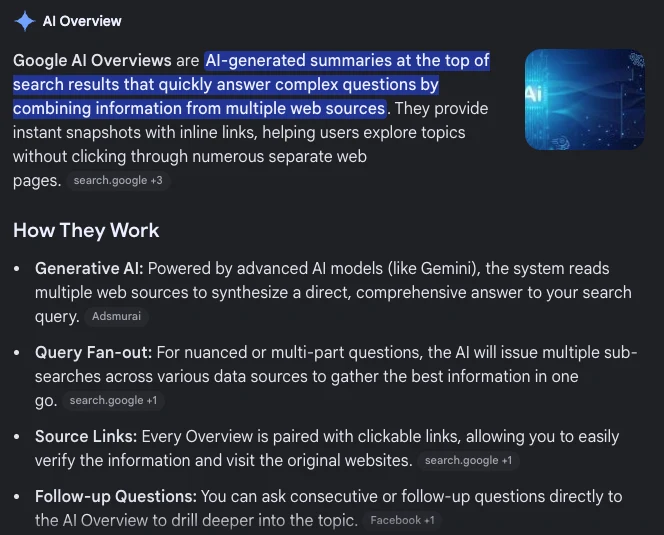
What Actually Changed: AI Overviews, AI Mode, and the Zero-Click Local SERP
Two product shifts collided in the first half of 2026. The first is AI Overviews - the generated answer box at the top of the SERP. The second is AI Mode, Google’s conversational interface that replaces the classic results page entirely when a user opts in. Together they’ve moved Google from a list of ten links to an answer engine with citations attached.
The data points worth memorizing:
- AI Overviews appear on roughly 83% of queries as of early 2026, up from a small fraction a year earlier
- Organic clicks are down about 58% year-over-year (Ahrefs, February 2026) on queries where an AI Overview appears
- Around 60% of searches now end without any click at all - the user reads the answer and leaves
- Roughly 32% fewer local businesses appear in AI-generated local packs than in the traditional 3-pack
That last number is the one local owners need to sit with. The traditional Map Pack was already a brutal three-slot game. The AI local pack is even narrower, and it’s selected by a different process - one that rewards a different mix of signals than classic local SEO.
If your strategy is still “rank for the keyword and wait for the click,” you’re optimizing for a SERP that’s shrinking under you. The new game is getting cited inside the answer itself.
Why Getting Cited in an AI Answer Is the New Position One
The old rule of local search was simple: be in the top three of the Map Pack and you win. The new rule is closer to this: be the source the AI quotes, or be invisible.
Citation positioning is now the most valuable real estate on the page for three reasons.
Citations carry the click that’s left. On the minority of queries where users do click, the AI’s source links convert at a much higher rate than blue links below the fold. Users have already read the answer and the citation is the validation step.
Citations build brand mentions even without clicks. A zero-click search where your business is named inside the AI answer still produces awareness. Multiple studies in early 2026 show direct-to-site traffic and branded search lifts following AI Overview citations - the click happened, it just happened later, on a different query, with intent already formed.
AI systems compound on themselves. Google’s AI, ChatGPT, Perplexity, and Bing’s Copilot all read each other’s outputs back into their training and retrieval. A citation in one becomes more likely in another. Brand mentions in trusted sources are now a ranking input across every AI search surface at once - the core mechanic behind what practitioners are calling local AEO (Answer Engine Optimization).
The shift is structural. Traditional position one was about ranking. The new position one is about being the answer.
The Content That Gets Cited (and What Gets Ignored)
After watching thousands of AI answer citations across local businesses we work with, the pattern of what gets pulled in versus what gets skipped is clear. The systems are not citing the highest-ranking page. They’re citing the most useful, most specific, most clearly authored one.
What gets cited:
- Locally specific cost guides. “How much does a new roof cost in Phoenix in 2026” gets pulled into answers far more reliably than “How much does a roof cost.” Specificity feeds the model the exact phrase it needs.
- Real project data. Case studies with named neighborhoods, real timelines, before-and-after photos, and dollar figures show up disproportionately. Generic service-page copy does not.
- Plain-language explainers from people with clear credentials. Author bylines with real bios, schema-marked, linked to LinkedIn or licensing bodies. E-E-A-T is no longer a content-marketing buzzword - it’s a literal signal AI systems use to decide who to trust.
- Direct answers to direct questions. Pages that lead with the answer in the first sentence, then explain, beat pages that bury the answer under context.
- First-party data. Survey results, internal benchmarks, original analysis. AI engines reward sources that contribute new information instead of re-summarizing existing ones.
What gets ignored:
- AI-generated content that summarizes other AI-generated content
- Service pages that read like every other service page in the category
- Pages with no clear author, no publication date, no schema
- Thin location pages built from a template with only the city name changed
- Pages that hedge every claim and refuse to give a number
The painful truth: a lot of what local SEO agencies have been shipping for years is now actively counterproductive. Templated content that ranks fine in classic search is exactly the kind of source AI systems strip out of their consideration set.
NAP Consistency and Review Signals That Feed the AI
AI Overviews and AI Mode are not just reading your website. They’re reading the broader web’s verdict on your business, and they’re cross-referencing it against your structured data.
Three signal layers matter more than they used to.
NAP consistency across the entire web. Name, address, and phone number agreement across Google Business Profile, your site, directories, and third-party platforms has always mattered for the Map Pack. It now also serves as a confidence signal for AI systems deciding whether your business is real, current, and the same entity referenced in those external mentions. Mismatches don’t just hurt rankings - they remove you from the candidate set entirely. Our local SEO service starts with this audit for a reason.
Reviews as ground truth. AI systems treat review content as one of the most authoritative inputs about a business. They’re pulling specific phrases, sentiment, and complaint patterns directly into answers. A business with 50 four-star reviews mentioning “fast response” will surface in “fastest [service] near me” answers in a way no on-page optimization can replicate. Review volume, recency, response rate, and specificity all feed this. A clean, actively managed review profile - the kind our review and reputation management service is built around - is now an AI visibility input, not just a conversion lever.
Structured data that matches reality. LocalBusiness schema, FAQ schema, and Article schema with valid author and date fields give AI systems the explicit metadata they need to confidently cite a page. Pages without it get treated as ambient text. Pages with it get treated as facts.
The businesses winning AI citations right now share a profile: tight NAP, high review velocity with substantive content, complete and accurate schema, and Google Business Profile fields filled out like they’re a piece of content - because they now are.
A Practical 2026 Action Plan for a Busy Owner
You can’t rebuild your entire web presence this quarter. You can make seven specific moves that compound. In priority order:

1. Audit and lock down NAP consistency this week. Pull your business name, address, and phone from your Google Business Profile, your site footer, your top 10 directory listings, Yelp, Apple Maps, Bing Places, and any industry-specific platforms. Pick one canonical version and fix every mismatch. This is the single highest-leverage thing you can do.
2. Treat your GBP description as AI-feeding content. Rewrite the 750-character description to cover specific services (not categories), years in business, service area boundaries, differentiators, and certifications. AI Overviews and “Ask Maps” pull from this field directly - the GBP management dashboard flags every field that’s still empty or underused.
3. Publish two locally specific cost or process guides per quarter. Pick the two most expensive or most-asked-about services you offer. Write them with real numbers, real timelines, real examples from your service area, and a real author byline. Lead with the answer in the first sentence. Add FAQ schema. These pages become your AI citation engine.
4. Get review volume up, with specificity. Aim for one new review per week minimum. Train your team to ask in a way that surfaces what you actually do well - “What was the biggest difference we made for you?” produces more citable content than “Please leave us 5 stars.” Reply to every review within a few days, not in batches. Our AI review response feature spaces these naturally so the pattern reads as a real business operating, not a bot.
5. Add author bios and date stamps to every content page. Cheap to do, structurally important. AI systems weigh authored, dated content over anonymous content. If you don’t have an author worth bylining, your founder’s bio is the right answer.
6. Build first-party data into at least one page per quarter. A small internal survey, a price benchmark from your own jobs, a before-and-after data point. Anything that makes your page a primary source instead of a secondary one.
7. Stop publishing thin location pages. If you have 40 nearly identical city pages with the city name swapped in, they are not just unhelpful - they are dragging down the perceived trustworthiness of your domain in AI systems’ eyes. Either rewrite them with genuinely local content (landmarks, neighborhood specifics, named local projects) or consolidate them. The same logic our AI SEO feature applies when surfacing topical-cluster gaps.
That’s the order. Move on whichever ones you’re weakest at first.
How to Measure AI Visibility
The metric most owners are still watching - organic clicks from Google Search Console - is the wrong primary number for 2026. Clicks will keep declining even as visibility holds steady or grows. You need a second instrument.
Three measurement layers to set up this quarter:
Impression growth in Search Console. Even as clicks fall, impressions on AI-eligible queries can climb. Tracking impression trend separately from click trend is the first signal that you’re being included in AI answers as a source.
AI citation tracking. Manually or with tooling, check whether your business is named or linked inside AI Overviews and AI Mode results for your top 20 commercial queries. Tools like WAIKAY, Profound, and Otterly are emerging to automate this. Even a manual spot check every two weeks is enough to detect direction. For a step-by-step method, the tools to use, and a simple scorecard to track over time, see how to track whether AI search is recommending your business. For the full step-by-step on earning those citations, see our answer engine optimization playbook for local businesses.
Branded search and direct traffic lift. Zero-click impressions still produce delayed conversions. A rising branded search line in GA4 or Search Console over a 60- to 90-day window is one of the cleanest signals that AI visibility is doing its job, even when classic organic clicks are flat or down.
Phone call and form-fill volume against an impressions baseline. The point of all of this is still customers. Track calls and form fills per 1,000 AI-eligible impressions - not per click. That ratio is the real business metric for local AEO.
If your impressions are rising, your AI citation rate is steady or climbing, branded search is up, and your call-per-impression rate is holding - you’re winning the new game even if the old metric is bleeding.
The Bottom Line
The shift to AI search is not a slow rebalancing. It’s a step change, and it favors local businesses that look credible, specific, and consistent across every surface AI systems crawl. The ones that win the back half of 2026 won’t be the ones with the most pages or the most keywords. They’ll be the ones the AI keeps quoting.
That comes down to clean structured data, locally specific content with real authorship, a review profile that reads like a real business in motion, and a GBP treated as a content surface rather than a directory entry. None of it is glamorous. All of it compounds.
Want a real picture of where you stand on the inputs AI systems actually weigh - reviews, GBP completeness, citation consistency, schema, local visibility? Schedule a free Renew Local audit and we’ll walk through your specific gaps and the moves that will move the needle this quarter. If you want a quick self-serve start, run the GBP health checklist first.
Related reading:
Ready to protect your Google Business Profile?
AI-powered review management and profile protection. Start your free 7-day trial.