AI visibility tracking is how you find out whether AI search tools name your business when someone asks for a recommendation. You do it two ways: run the real questions your customers type into Google’s AI Mode, ChatGPT, Gemini, and Perplexity, then write down if and how your business shows up, and second, use an AI visibility or local rank tracking tool to watch those answers change over time. Regular keyword rank trackers cannot read inside an AI answer, so they miss this entirely. Below is the manual method, the tools worth paying for, and how to turn what you learn into more mentions. If your goal is to actually earn those mentions, pair this with our guide on getting your business cited by AI.
This matters right now because the front of search has moved. Google’s AI Mode passed one billion monthly users and became the global default in Search (Google, I/O 2026, May 2026), and assistants like ChatGPT and Perplexity answer local questions without a click. Your old rank report can look fine while the AI quietly recommends someone else.
Key takeaways
- AI visibility means whether AI search and assistants mention your business by name in their answers, which is different from where your website ranks in the blue links.
- Old keyword rank trackers cannot see inside AI answers, so you need manual checks plus a tool built for AI search.
- The fastest free check is to ask the main assistants the real questions your customers ask and record whether you appear, where, and how you are described.
- Paid AI visibility and local rank tracking software automate those checks across prompts and platforms and show the trend.
- Track a short list over time: appearance rate, position, sentiment of the mention, and which sources the AI cites.
What AI visibility means, and why old rank trackers miss it
AI visibility is whether AI search features and assistants name and recommend your business inside their generated answers. It is not the same as a keyword ranking. A keyword rank tracker tells you your page sits at position four for “roof repair.” It says nothing about whether Google’s AI Overview, the box of AI-written text at the top of the results, listed three roofers and left you out.
That gap is the whole problem. AI Overviews visibility and blue-link ranking are measured differently and often disagree. You can hold a strong ranking and still be absent from the answer most people read first, and now that Google can call businesses on a customer’s behalf, being named in that answer decides who even gets the call. This is why answer engine optimization (AEO), the practice of getting quoted by AI, and generative engine optimization (GEO), the practice of getting named inside AI-generated text, now sit next to classic search engine optimization instead of replacing it. We mapped how far this has spread in why AI Overviews are eating local clicks.
Old trackers miss AI answers for a simple reason. They read the standard list of results. AI answers are generated fresh, they change by phrasing, location, and account, and they name businesses in prose rather than in a ranked list. To see them, you have to look at the answer itself.
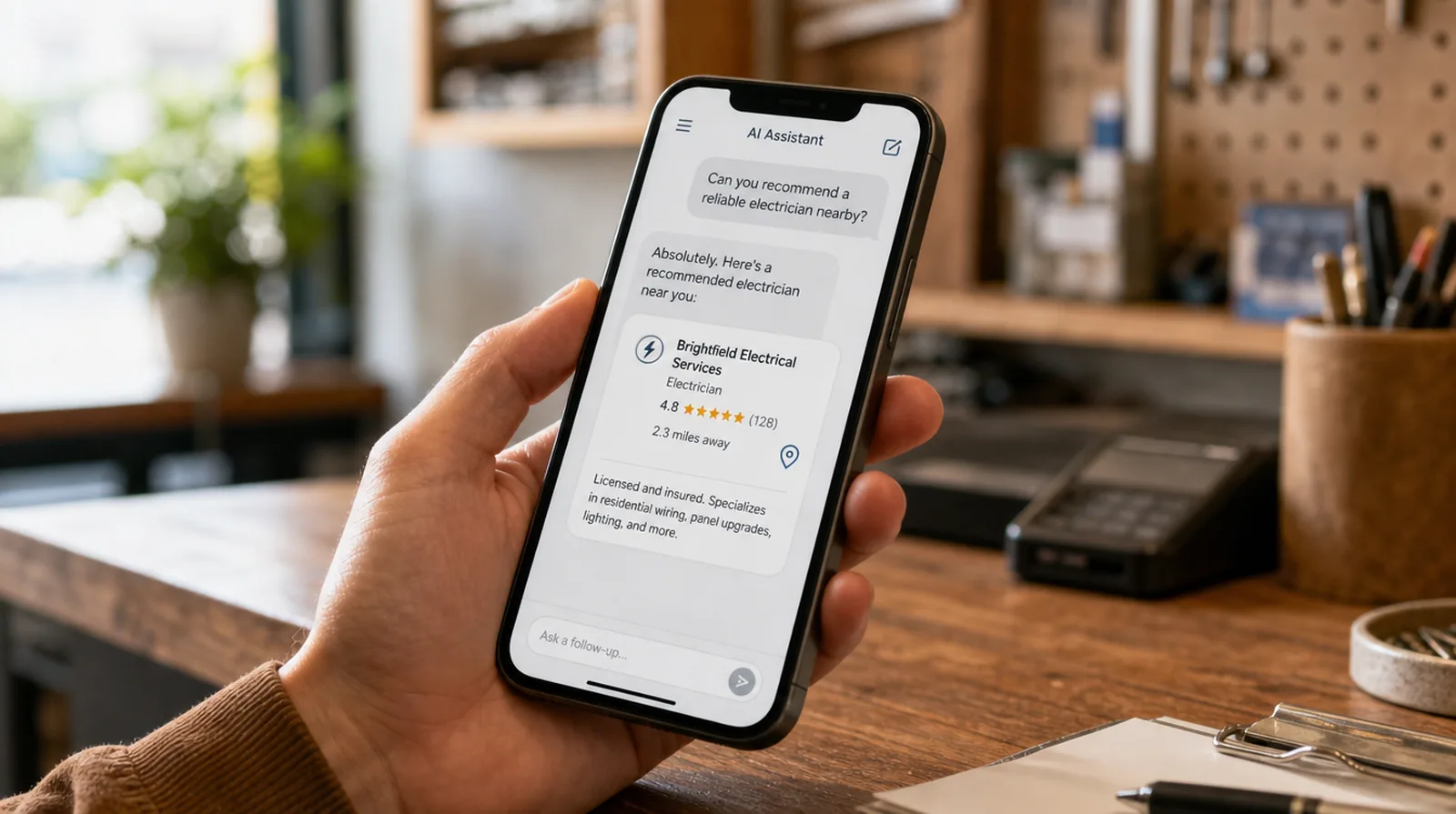
Simple manual ways to check whether AI names you
The quickest way to check is to become your own customer for ten minutes. Open each assistant and ask the questions a real buyer asks, then record what comes back. This costs nothing and shows you exactly what a shopper sees.
Run the same short list of prompts through Google’s AI Mode, ChatGPT, Gemini, and Perplexity. Use natural phrasings, not keywords:
- “Best [your service] near [your city]”
- “Who should I call for [specific problem] in [your area]?”
- “Is [your business name] any good?”
- “[Your service] companies in [your city] with good reviews”
For each one, write down four things: did your business appear, where in the answer, how were you described, and which websites did the AI cite as sources. That last column is gold, because those cited pages (your Google Business Profile, a directory, a review site) are the places feeding the answer. To track your business in ChatGPT specifically, turn on its web search mode so it pulls live results rather than older training data, and ask from a logged-out or fresh session so your history does not skew the answer.
Do this from your actual service area. AI answers are location-aware, so a check from another city tells you little. Keep the results in a simple spreadsheet with the date. One pass is a snapshot. The same pass every month is a trend.
What AI visibility tools do, and what to look for
AI visibility and local rank tracking software automate the manual check. Instead of you typing prompts by hand, these AI SEO tools run a set of questions across assistants on a schedule, log whether you appear, and chart the movement. They save hours and catch changes you would miss checking once a quarter.
When you compare AI SEO tools, look for a few things: which platforms they actually cover (Google AI Overviews and AI Mode, ChatGPT, Gemini, Perplexity), whether they track by your real location, whether they capture the sources the AI cited, and whether they measure sentiment, meaning whether the mention was positive. Costs vary widely by provider and plan, so treat the ranges below as ballpark, not quotes.
| Tool type | What it tracks | Look for | Rough monthly cost |
|---|---|---|---|
| AI visibility tracker | Whether assistants name you and how often | Multi-assistant coverage, cited sources, sentiment | Low tens to low hundreds |
| Local rank tracking software | Map pack and local position by location | Grid tracking, per-city results | Low tens to mid hundreds |
| All-in-one local platform | Rankings, reviews, and AI mentions together | AI answer monitoring plus review tools | Low tens and up |
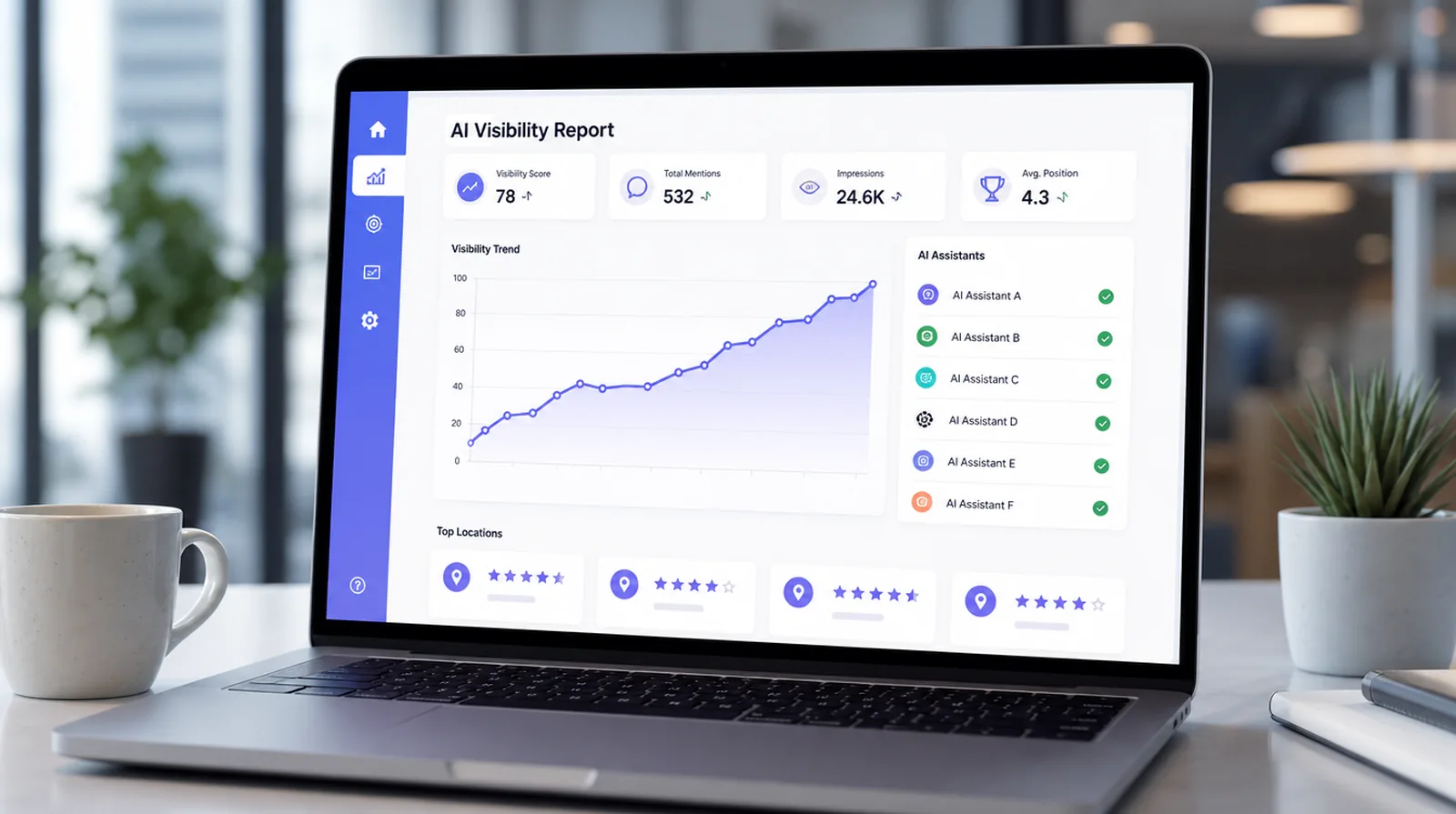
Once you know where you stand, the fix is to strengthen the signals AI reads. Renew Local provides AI-powered Google Business Profile management, review management, and local rank tracking for local businesses. That work lifts your local rankings and keeps your reviews and listings clean, which are the signals that improve your visibility in AI search. Whatever tool you use to measure, the point is the same: what the AI shows a real customer is what matters, not just where a page ranks.
How to turn what you find into more mentions
Once you know where you are missing, fix the signals AI reads before it picks a name. Four moves do most of the work, and they overlap with strong local SEO.
Content. AI quotes clear, direct answers. Add short, plain answers to the exact questions your customers ask on your service pages, with the answer in the first sentence so it makes sense quoted on its own.
Structured data. Mark up your pages with LocalBusiness and FAQ schema so machines can read your name, services, area, and hours without guessing.
Reviews. AI treats reviews as ground truth. Steady, recent, genuine reviews that you reply to feed the mention. Never gate reviews or buy them, since that breaks Google policy and a federal rule and can cost you visibility. More on that in how your reviews feed AI answers.
Entity consistency. Your name, address, and phone number must match across your website, your Google Business Profile, and directories. When the details disagree, AI loses confidence and leaves you off the list.
How often to check, and what to track over time
Check monthly for most local businesses, and weekly if you are in a competitive market or recovering from a drop. AI answers shift with model updates and new reviews, so a single check ages fast. A monthly pass on the same prompts turns noise into a real signal.
Keep the scorecard short so you actually maintain it. Track four numbers over time:
- Appearance rate: the share of your core prompts where you get named at all.
- Position and prominence: are you first, buried, or a footnote in the answer.
- Sentiment: is the mention positive, neutral, or a warning.
- Cited sources: which of your pages and profiles the AI is pulling from, so you know what to strengthen.
Watch the direction, not any single day. If your appearance rate climbs and the AI keeps citing your Google Business Profile, your work is landing. If it drops, that is your early warning to check your reviews, your listings, and your content before the phone goes quiet.
Frequently Asked Questions
Can I see if ChatGPT recommends my business?
Yes. Turn on web search in ChatGPT, then ask it the questions your customers ask, like “best [your service] in [your city],” from a fresh or logged-out session. Note whether it names you, how it describes you, and which sites it links as sources.
Do normal keyword rank trackers show AI Overviews?
Most traditional rank trackers only read the standard list of results, so they do not show whether you appear inside an AI Overview or AI Mode answer. You need a tool built for AI search visibility, or a manual check, to see that.
How often should I check my AI visibility?
Monthly works for most local businesses. Check weekly if your market is competitive or you are recovering from a ranking or review drop, since AI answers change with model updates and new reviews.
Are AI visibility tracking tools worth it for a small business?
If AI search sends you customers, yes, because you cannot improve what you cannot see. Many owners start with free manual checks, then add a paid tool once they want the trend tracked automatically across platforms. Costs vary by provider and plan.
Start tracking your AI visibility
AI search now decides who gets recommended before a customer ever clicks. The businesses that win are the ones watching what the AI says about them and then fixing the signals behind it. Renew Local runs AI-powered Google Business Profile management, review management, and local rank tracking, the work that lifts your local rankings and reviews so AI search is more likely to name you.
Start your free 7-day trial or book a demo and we will help you strengthen the rankings and reviews that AI search reads.
Ready to protect your Google Business Profile?
AI-powered review management and profile protection. Start your free 7-day trial.