Yes, Google can now call a local business on a customer’s behalf. It phones you to ask about pricing, availability, and services, then hands the customer a clean summary of what it heard. Google announced this at its I/O event on May 19, 2026, and said the feature would roll out to everyone in the United States this summer for categories including home repair, beauty, and pet care (Google, May 2026). So the next caller asking your front desk for a quote may be Google AI calling local businesses for a real person, and the shop that answers clearly wins the job.
I run visibility and reputation work at Renew Local, an AI-powered Google Business Profile management and reputation platform used by local service businesses across the U.S. The habits that impress a good customer now impress the machine calling for them. For the wider picture on getting named by AI, start with our guide to answer engine optimization for local businesses.

Key takeaways
Google’s AI can call local businesses for customers, and the U.S. rollout for home repair, beauty, and pet care began this summer (2026). An AI caller checks what a good customer checks, plus one extra: whether your website and Google Business Profile agree with what your staff says on the phone. The businesses that get recommended have accurate hours, plain pricing, a real booking path, and steady recent reviews. Fix your profile first, make your answers easy to quote, then track whether AI search names you. None of this needs a developer.
What Google announced about AI calling local businesses, live versus rolling out
At Google I/O on May 19, 2026, Google said it is expanding agentic booking in Search to local experiences and services, and that for categories including home repair, beauty, and pet care, people can ask Google to call businesses on their behalf (Google, May 2026). Google said these capabilities would roll out to everyone in the U.S. this summer, and that AI Mode passed one billion monthly users.
The pieces landed at different times, so here is the honest status:
- Already live: Google’s “Let Google call” feature for shopping. A person can ask Google to call nearby stores about product availability and discounts, and Google reports back (Google, 2026).
- Rolling out this summer (2026): the same call-on-your-behalf ability aimed at local services, starting with home repair, beauty, and pet care.
- Live for some users: agentic booking for restaurant reservations, with local service appointments named as coming next (Google, 2026).
Treat “this summer” as now. If you serve one of those categories, assume an AI could call this week.
What an AI caller needs from you that a website visitor does not
An AI caller needs answers it can repeat back word for word: an exact price or range, an open time slot, and confirmation you do the specific job. A website visitor forgives a vague page because they can poke around and call back if unsure. The AI asks a direct question, records the answer, and reports it. Fuzzy replies like “it depends, call us back” turn into a blank in the customer’s summary, and a blank loses to a competitor who gave a number.
The AI also checks something a human never could at that speed: whether your phone answer matches your website and your Google Business Profile. When your site says you close at 6, your profile says 5, and your staff says 7, the AI logs three businesses’ worth of confusion. Consistency is the new curb appeal.

Here is the fair side-by-side. Both callers judge you on the same seven things. The AI is just faster, more literal, and never charmed.
| What gets judged | Human caller | AI caller (calling for a customer) |
|---|---|---|
| Speed to answer | Will wait, leave a voicemail | Moves to the next business if no one picks up |
| Clear pricing | Accepts “roughly” and a callback | Wants a number or a stated range, now |
| Hours and availability | Checks once, trusts it | Cross-checks phone, site, and profile for a match |
| Services offered | Reads between the lines | Needs the exact service named plainly |
| Review signals | Skims a few star ratings | Reads volume, recency, and your replies |
| Structured data on the site | Ignores it | Uses it to confirm hours, price, and booking |
| A real booking path | Will call back to book | Wants a link or slot it can act on |
Get your Google Business Profile facts right: hours, services, service area, and booking links
Google Business Profile accuracy is the highest-value fix, because your profile is what Google reads before and after it calls. Check four things line by line: your hours (including holiday hours), your full service list with plain names, your service area or address, and a working booking link. If any are stale, the AI starts the call unsure who you are.
Three mistakes we fix constantly: owners list a category but never add the actual services under it, so “drain cleaning” or “balayage” never appears in a form the AI can match; old holiday hours sit there from last year; and many profiles have no booking link at all, so the AI has nowhere to send the customer after a good call. Pick the right categories first, since everything depends on them, and our guide to choosing Google Business Profile categories walks through it. If keeping this current by hand is a losing battle, a Google Business Profile management dashboard syncs hours, services, and links in one place.
Make your pricing and availability answerable: structured data, frequently asked questions, and a real booking path
Make your prices and availability easy to quote by putting them in plain sentences and in structured data, and by giving the customer a real booking path. Structured data, also called schema, is a small block of code that labels your page so machines read your hours, prices, and services correctly instead of guessing. You do not need to write it by hand, but it needs to be present, because it is how an AI confirms on your site what it heard on the phone.
Three moves that pay off fast:
- Answer the top questions in plain words. Add a short FAQ to your key pages with real ranges, timelines, and what is included. “A standard service call runs $89 to $149 depending on the work” is quotable. “Contact us for pricing” is not.
- Add schema and structured data for your business, services, and FAQ so those answers are machine-readable. This is core to AI search optimization, also called answer engine optimization (AEO).
- Give one clear booking path. A single obvious button to book, request a quote, or check availability. Neither the AI nor the customer should have to hunt for it.
One caution on pricing: any number you publish should read as a general range that varies by job, brand, and market, not a locked quote, and you should confirm with a written, itemized estimate. That protects you and still gives the AI something concrete to repeat.
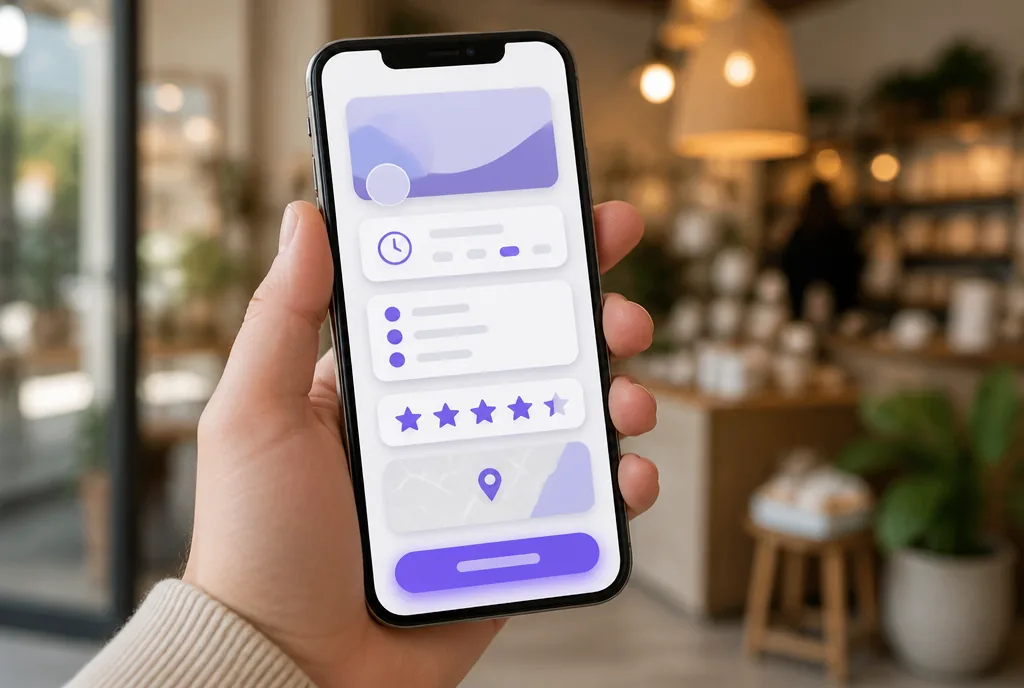
Reviews are now training data for the answer: what online reputation management looks like when an AI reads your reviews
Your reviews are training data for the AI’s recommendation, so online reputation management (ORM) is no longer damage control, it is feeding the machine good signal. When Google’s AI decides which business to call or name, it reads your review volume, how recent they are, whether you reply, and the exact words customers use. A profile with fresh reviews that say “showed up on time” and “gave a fair price” tells the AI you are the safe pick for those searches.
Practical ORM here is simple and steady: ask every happy customer for a review, reply to all of them in your real voice, and keep a recent flow going instead of a one-time burst. Replies matter more than people think, because they show the AI an owner who is present and add keywords the machine can match. If replying to every review is where you fall behind, an AI review response tool drafts on-brand replies you approve in seconds, and our reputation management service handles the harder cases. For why this pays off, see the numbers on what Google reviews are worth.
How to check whether AI search is quoting you, and what to fix first
Check whether AI search names you by asking the AI tools the way a customer would, then fixing the gaps. Open Google’s AI Mode, ChatGPT, and Gemini and type the searches your customers use, like “best [your service] near [your city].” See if you get named, and note what the AI says about your hours, price, and services. If it is wrong or silent, that is your to-do list.
Doing this by hand is fine to start. To watch it over time, AI visibility tracking shows whether and how often AI search recommends you, and local rank tracking software shows where you stand on the map for the searches that matter. Pair those with strong local SEO so the profile and pages the AI reads are solid underneath. Our blog covers the rest of the AI search shift for local owners.
Do this first: your priority list
Work these in order. Each one takes an afternoon or less.
- Fix Google Business Profile accuracy. Correct hours, holiday hours, full service list, service area, and a working booking link today.
- Make one clear phone answer. Decide the price ranges and availability your team will state out loud, so the phone matches the profile.
- Publish plain, quotable answers. Add a short FAQ with real ranges and timelines to your top pages.
- Add schema and structured data for your business, services, and FAQ.
- Turn reviews back on. Ask recent customers, reply to every review, keep it steady.
- Track your AI visibility. Search yourself in AI tools monthly and fix whatever is wrong or missing.
Do these six and you are ready for the AI caller, and for the human one too.
Frequently Asked Questions
Can Google really call my business for a customer?
Yes. Google said at I/O on May 19, 2026 that people can ask it to call businesses on their behalf for categories including home repair, beauty, and pet care, rolling out to everyone in the U.S. this summer (Google, 2026). A related “Let Google call” feature for shopping is already live in the U.S.
What does Google’s AI caller ask a business?
It asks the same practical questions a customer would: your prices or ranges, whether you have availability, and whether you do the specific job. It records the answers and sends the customer a summary, so clear, direct replies beat “it depends, call us back.”
How do I make sure Google’s AI recommends my business?
Get your Google Business Profile accuracy right, publish plain prices and answers backed by schema and structured data, keep recent reviews with replies, and give one clear booking path. Then check the AI tools monthly to confirm they name you correctly.
Do I need special software to be ready for AI calling?
No, the core fixes are free and manual: correct your profile, answer the phone clearly, and post plain prices. Review management software and AI visibility tracking help you stay consistent at scale, but the foundation is accurate information stated the same way everywhere.
What is answer engine optimization, and does it help here?
Answer engine optimization (AEO) is shaping your content so AI tools quote and recommend your business. It helps directly, because the same clear answers, consistent details, and structured data that get you cited in an AI answer are what an AI caller confirms on your site.
Renew Local helps local businesses across the U.S. keep their Google Business Profile accurate, manage reviews, and stay visible in AI search. Start a free trial or book a demo to see it work on your own profile.
Ready to protect your Google Business Profile?
AI-powered review management and profile protection. Start your free 7-day trial.