If you’ve noticed Google reviews vanishing from your profile, replies getting rejected, or new reviews failing to publish, you’re not alone. Google has quietly rolled out a wave of policy updates, AI-powered filtering, and API-level controls that are reshaping how local businesses earn and keep their reviews.
At Renew Local, we manage review generation and reputation at scale for hundreds of local businesses - which means we’re watching these shifts play out across thousands of review events every month. The patterns are clear, the rules are changing faster than most business owners realize, and the businesses that adapt first are going to take significant local market share from the ones that don’t.
Here’s what’s actually happening, and what to do about it.

The Patterns Behind Disappearing Reviews
Tracking reviews across hundreds of businesses has surfaced consistent patterns in which reviews get filtered or pulled down. None of these are officially documented Google policy - but they show up often enough in the data to be treated as working rules.
On-premise review requests violate Google policy. Google’s review guidelines explicitly prohibit asking for reviews while the customer is still in your establishment. This is the single most overlooked rule in local SEO - and it lines up with the broader crackdown we’ve covered in Google Removing Reviews in 2026.
QR codes are a risk vector. QR codes themselves aren’t banned, but they’re almost always scanned on-premise - at the checkout counter, in the waiting room, on the table. That’s where the policy collides with real-world execution. We’ve seen cases where a customer scanned a QR code inside a business, left a review before leaving the building, and the review was deleted within a week.
Edited reviews are getting removed disproportionately. If a customer posts a review and then edits it, the edited version appears to receive extra scrutiny.
Reviews that name employees are being flagged. First-name mentions of specific staff members correlate with removal - Google’s prohibited and restricted content policy treats personal-information mentions as a moderation trigger.
Low-engagement reviewer accounts look like low-trust signals. If a reviewer has never searched for your business, never viewed your profile, never tapped your call button, and never clicked through to your website, the algorithm has no prior relationship to validate. These reviews appear more likely to be filtered. It’s not absolute - a trusted local guide leaving their 80th review probably gets through regardless - but for average reviewers, engagement before the review seems to matter.
The QR Code Fix Most Businesses Miss
One of the most actionable fixes for QR code filtering: instead of pointing your review QR code directly at the Google review link, point it at a branded search URL using the business’s Place ID.
Here’s why it matters. Most businesses use the review URL Google provides - the one that drops customers straight into the review panel. This bypasses every engagement signal Google’s algorithm uses to validate the review. Pointing the QR code at a branded search instead turns the scan into something Google recognizes: the customer lands on a real Google search for the brand, sees the knowledge panel, and leaves the review from there.
Why this works:
- It creates a legitimate navigational search signal
- The customer sees the profile before reviewing (engagement Google can verify)
- The review request now looks like a normal user journey, not a drive-by
It doesn’t fully solve the on-premise problem - if someone scans at the counter, they’re still on-premise - but it significantly reduces the trust issues that cause filtering.

Google Is Now Policing Review Replies Too
A quieter but significant change: the Google Business Profile API now returns response states of pending, rejected, or approved when businesses post replies to reviews.
This is new. Previously, replies published instantly with no moderation layer. Now Google is running replies through scrutiny similar to what it applies to the reviews themselves.
The likely target is AI-generated reply spam. Tools that auto-respond to 50 or 100 reviews in a single batch - all written in seconds by the same AI - create a footprint Google can identify. We’ve seen cases where a business reported being blocked from receiving new reviews after using a tool to reply to 100 reviews at once. It’s not proof of cause and effect, but it’s consistent with Google’s broader direction.
What to do: If you use AI to draft review responses, the approach matters more than the automation itself. Bulk auto-reply to every new review in 30 seconds is exactly the pattern Google is filtering against. Drafting personalized responses, reviewing them before publishing, and spacing them across realistic intervals is a fundamentally different behavior.
This is exactly why we built Renew Local’s AI review response feature the way we did. Instead of batch-firing dozens of replies at once, Renew Local responds to reviews shortly after they post - so your responses stay naturally spaced, the way Google expects real businesses to operate. You can customize the tone so replies sound like you, not a template, and every draft gets reviewed and approved before it goes out. It’s AI that actually helps you scale, without the footprint that’s getting other businesses penalized.
AI Visibility Is a New Optimization Layer
Case studies coming out of the local SEO community are starting to show measurable AI visibility lifts from a surprisingly simple change: topical consolidation. One recent example showed a 10% increase in AI visibility from creating a new category page and reorganizing existing legacy blog content to support it - no new content required.
The takeaway: AI systems appear to reward topical consolidation more than raw content volume. If you’ve been publishing blog posts for years without organizing them into coherent topic clusters, there’s probably visibility sitting on the table. Tools like WAIKAY (What AI Knows About You) are starting to emerge to help businesses benchmark how AI systems describe them - and our own AI SEO feature helps surface the same topical gaps before they cost you traffic.
Reddit, YouTube, and X Are Now in the SERP
Google’s “What People Are Saying” feature now pulls live discussions from Reddit, YouTube Shorts, and X directly into search results. Three implications for local businesses:
- Reddit and YouTube presence is no longer optional for competitive verticals. If your customers are researching you and the SERP surfaces a Reddit thread you’re not part of, you’ve lost the narrative.
- Video is the new long-form content. Short-form video is getting pulled into mainstream results in a way written content used to own.
- Authenticity is effectively a ranking input. Polished marketing copy competes against raw user discussion, and raw user discussion often wins.
For agencies, the implication is uncomfortable. Getting clients to produce blog content is already a struggle. Getting them to produce video is another level entirely. But the direction is clear.

GBP Description Optimization Actually Matters Now
For years, the GBP description was a throwaway field. It didn’t influence rankings in the local pack or Maps, so optimization advice was basically “fill it out and move on.”
That’s changed. AI Overviews and “Ask Maps” now pull directly from the description field. This means the description is functionally a piece of AI-optimized content, not a throwaway. (If you want a structured walkthrough of every GBP field that’s now pulling weight, our GBP posts guide covers the adjacent surface area.)
A good description should cover:
- Specific services offered (not just categories)
- Years in business
- Service area specifics
- Differentiators from competitors
- Specializations or certifications
Treat it like a 750-character pitch that feeds AI systems, because that’s what it is now.
Stats Worth Knowing
Recent industry coverage of Google’s small business playbooks has surfaced some numbers worth internalizing, with appropriate caveats - some of the underlying sources aren’t fully documented, so treat these as directional:
- Businesses with complete Google Business Profiles are reported to get roughly 7x more clicks than incomplete profiles
- Adding photos is associated with approximately 42% more direction requests
- Crate & Barrel’s published Uberall case study shows a 31% increase in Google Map Views and a 6% increase in Google Search Views year-over-year (2024 vs. 2023), alongside 95% GBP completeness across their 161 US and Canada locations. This is the strongest data point of the set because it’s a documented case study, not a repeated statistic.
On the messaging side, consumer preference data is mixed and context-dependent. SimpleTexting’s 2024 report found that when asked how they’d prefer to contact a business with a question, 32% of consumers chose email, 28% texting, 19% phone, and 19% live chat, with texting leading for younger demographics. EZ Texting’s 2026 report shows texting surpassing phone as a preferred business contact method (46% vs. 43%) in the “always or most of the time” bracket.
The takeaway: messaging is rising fast, but it hasn’t universally displaced other channels. Context matters. In practice, messaging as a GBP feature works well for home services and solo operators, but breaks down for high-volume categories like restaurants where inboxes get overwhelmed and spam-heavy.
Google Posts remain one of the most underused tools in the stack. They’re not a direct ranking factor, but the Crate & Barrel data supports what we’ve observed for years: consistent posting keeps users on your profile longer, functions as free advertising inside the knowledge panel, and produces measurable engagement lifts.
How Renew Local Fits Into This
Everything covered so far comes down to one thing: your reputation on Google is getting harder to manage, and the businesses that win are the ones paying attention to the details most owners ignore.
Renew Local is built specifically for this reality. We focus on the parts of your reputation you can actually control:
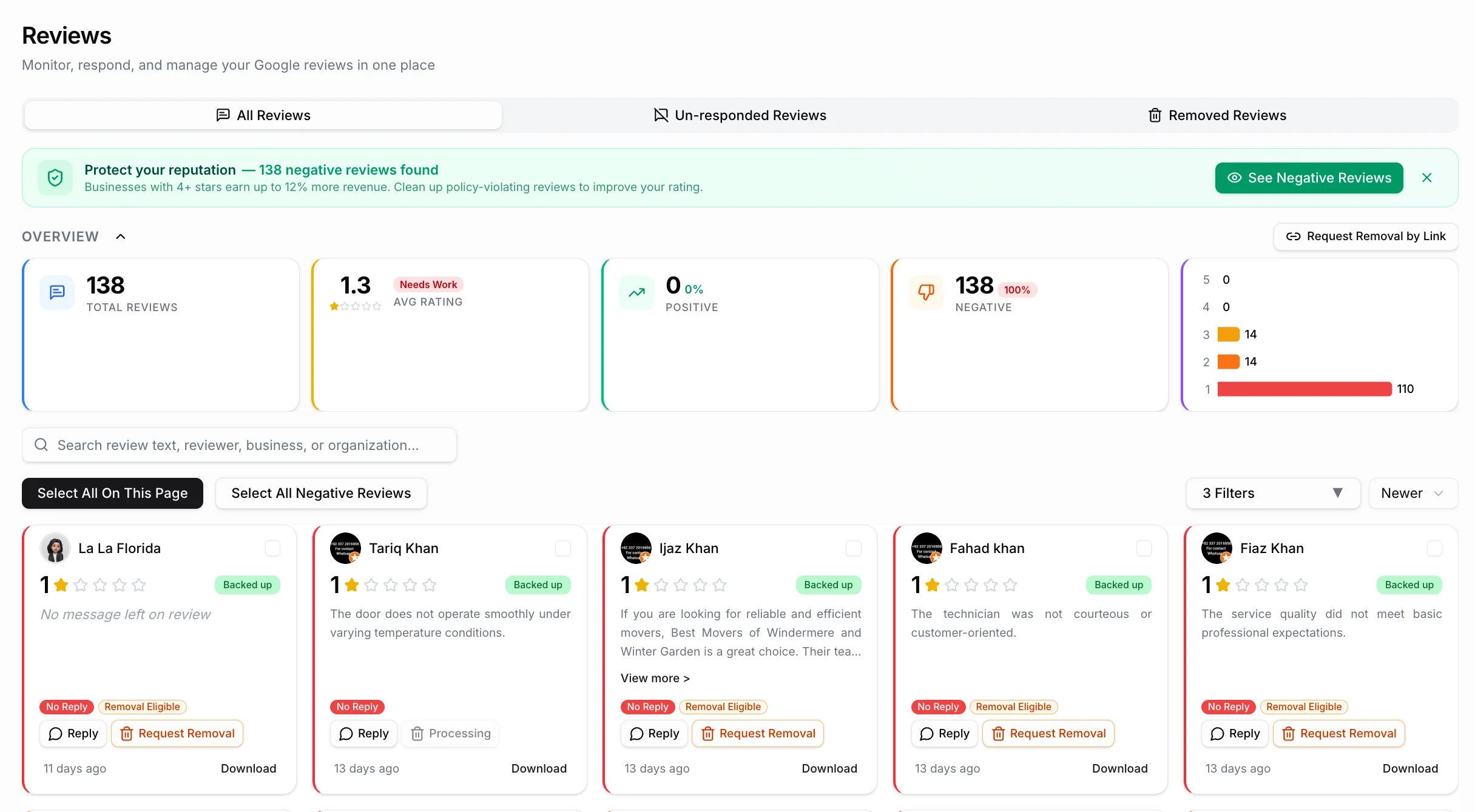
A cleaner review profile. The GBP Management Dashboard shows you every review on your Google Business Profile and notifies you when low-star reviews come in, so nothing slips past you. If one looks fake or suspicious, you can flag it for a dispute in one click - our Google Review Dispute service handles the submission to Google. When Google takes it down, your dashboard updates automatically, so you always have a clear record of the cleanup happening on your listing.
AI responses that don’t get you penalized. Our AI review response feature replies to reviews shortly after they post, not in bulk batches. That keeps your response pattern naturally spaced - the way Google expects real businesses to operate. Tone is customizable so replies sound like you, not a template, and every draft is reviewed and approved before it posts. That’s the difference between helpful AI and the pattern Google is filtering against.
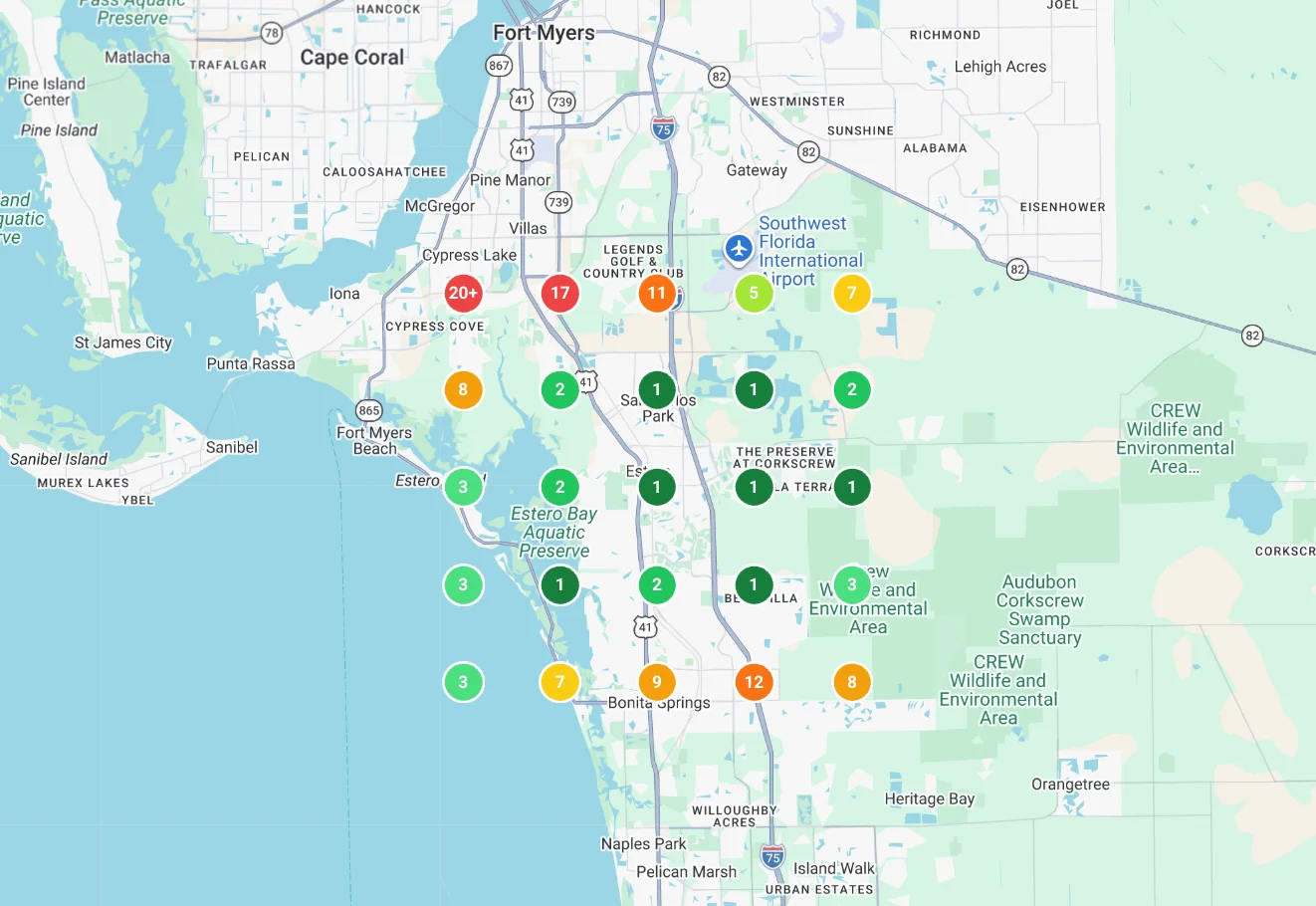
Visibility across your actual service area. Heat map tracking on our paid plans shows your real rankings across a geographic grid - not just where Google serves you at your office. Competitor tracking shows you who’s beating you in each area, so you can prioritize the neighborhoods and keywords that matter most.
None of this is magic. It’s just doing the fundamentals right, with tooling that tells you what’s actually happening instead of leaving you to guess.
The Bottom Line
Google’s review ecosystem is getting more sophisticated, more filtered, and more AI-driven at every layer. The businesses that win in 2026 won’t be the ones gaming the system harder. They’ll be the ones that:
- Understand the policies well enough to avoid accidental violations
- Collect reviews through clean, engagement-first flows
- Keep their review profile clean by actively identifying and removing fake reviews
- Treat AI visibility as a first-class optimization target
- Use their GBP as a structured content surface, not a directory listing
The gap between businesses doing this well and businesses still operating on 2022 playbooks is widening fast. The ones who close it first will own their local markets.
Want a cleaner review profile, AI responses that sound like you, and real visibility into your local rankings? Start your free Renew Local trial - or see the full review and reputation management service if you want the team to run it for you. To see what every star is actually worth on your specific revenue and the exact reviews needed to climb past competitors, run the numbers in our review impact calculator.
Related reading:
- Google Removing Reviews in 2026: What Every Business Owner Must Know
- How to Remove Negative Google Reviews
- The Ultimate Guide to Google Business Profile Posts
- 7 Reasons an AI Review Response Generator Is Essential
Sources referenced: Whitespark Local Search Update podcast (Darren Shaw, Claudia Tomina); Uberall Crate & Barrel case study; SimpleTexting 2024 report; EZ Texting 2026 report.
Ready to protect your Google Business Profile?
AI-powered review management and profile protection. Start your free 7-day trial.